


Pro-lifers are still taking stock after the midterm election, which unfortunately delivered major wins for pro-abortion ballot measures. Nevada and Virginia voters wrote abortion into their state constitutions, and Missouri voters failed to repeal the abortion amendment they approved in 2024. Idaho was one of the few bright spots: voters there rejected a measure that would have created a “right” to abortion up to viability. “Fetal viability” is the key term in this year’s ballot measures and in many of those already approved in post-Roe America. So, what is “fetal viability,” and why does it matter?
What Does “Viability” Mean?
Fetal viability is the point at which a baby could survive outside the womb, usually with medical support. A standard pregnancy lasts 40 weeks, and a baby is considered full-term at 39 weeks’ gestation. Full-term babies are typically ready for the world and require little to no medical intervention. The more prematurely a baby is born, the more help he or she needs to breathe, regulate body temperature, and eat. So where, exactly, does “could survive” begin?
That turns out to be surprisingly hard to answer. The American College of Obstetricians and Gynecologists (ACOG), which supports abortion, is reluctant to name a specific week. The first specific age range for which it lists survival statistics is 23 weeks, and many hospital websites put viability at 24 weeks. Yet a few babies have been born and survived even earlier, the youngest at 21 weeks.
Logically, the point of viability ought to be the youngest age at which a baby has been born and survived. The fact that doctors can’t settle on one number across the board is telling. ACOG itself strongly discourages writing viability into law, yet Nevada’s new constitutional amendment, for one, is built around it. If the experts can’t define the line, why make it the legal one?
Why Viability Is a Shaky Line
Viability is a moving target, and it shifts as medicine advances. Not long ago, viability came much later in pregnancy, because medical science lacked the means (and the meds) to help preterm babies continue their development outside the womb. As mentioned, the youngest premature baby on record to survive was born in 2024 at just 21 weeks and 0 days.
“Fetal viability” measures our medical capability, not the child’s nature or worth.
This matters because courts, legislators, and ballot measures treat viability as a fixed biological milestone when it isn’t. A premature baby’s odds vary from child to child and from hospital to hospital, and not every hospital has a world-class NICU. Staking a human being’s worth on an accident of geography is both unethical and illogical.
What Viability Can’t Tell Us
Abortion supporters often search for an arbitrary point in human development at which a baby “earns” the right not to be killed. For some, it’s when the heart starts to beat around 21 days after conception. For others, it’s when the baby may be able to feel pain, which most don’t realize could be as early as 12 weeks. Still others draw the line at brainwaves, or even fingernails. But none of these milestones, viability included, can tell us whether a baby is human or has intrinsic worth.
Of note, this is not to be confused with how pro-life groups – including Human Coalition – periodically support imperfect pro-life legislation. Make no mistake: the mission is that abortion is made unthinkable and unnecessary. But it’s not going to happen overnight. Pro-life groups support incremental bills not because we think babies become valuable at any point other than their conception, but because we want to save as many lives as possible along the way.
The only thing every single human on earth has in common is our humanity. Our species, our shared human DNA, is the only non-arbitrary standard for human worth. A baby’s humanity doesn’t begin at viability, or at any of these other developmental stages. As pro-life apologist Randy Alcorn points out, “What is human is human from the beginning.”
Steven Schwartz’s SLED Argument1 shows why these differences don’t change what a baby is:
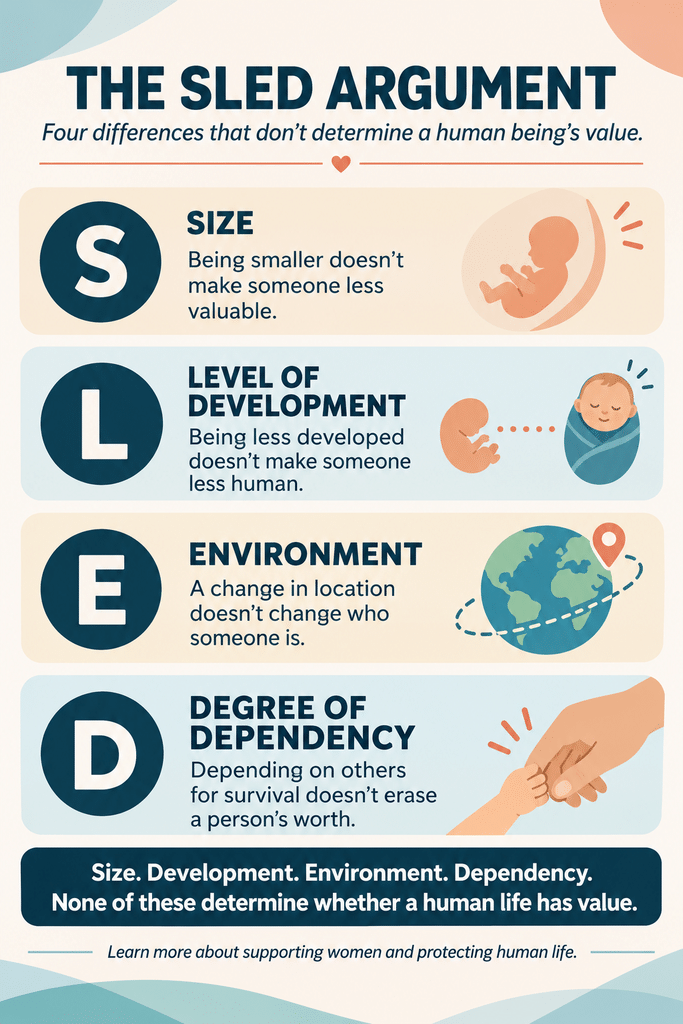
Viability laws imply that a human being’s worth hinges on his or her independence. If that’s the standard, many born people would be in the same trouble: children, even well into their teens; people with disabilities who rely on caregivers; the elderly who have lost their independence due to natural aging. History warns us what happens when we start to believe that “personhood” equals “human + something else.”
What Now?
The fight for life presses on. Principled pro-lifers will keep pushing for the best, most life-affirming laws possible in every state, with the goal of making abortion unthinkable and unnecessary. Human Coalition and our supporters play a particular role in this mission: rescuing children by caring for moms.
Human Coalition and Planned Parenthood strive to reach the same woman: a mom in crisis who is considering abortion, whether or not she truly wants one. Data shows that most women seeking abortion don’t want one, yet they feel it’s their only option due to external factors like finances or an unsupportive partner. Human Coalition stands in the gap to offer hope and help solve the problems that brought a woman to the verge of choosing abortion.
Join our family of supporters today and help rescue the next mom and baby from abortion.